The Summer Sky in 2026: What to Watch and Why It Matters
The summer sky of 2026 is unusually eventful — a Venus-Jupiter conjunction, a near-total solar eclipse, the Perseid meteor shower, two eclipses, and three full Moons, all within three months. This guide covers every major event with exact dates, how to observe them, and the deeper question each one raises: why have humans been tracking these moments for thousands of years, and what does that say about us?
The Summer Sky in 2026: What to Watch and Why It Matters
From a rare planetary kiss to a near-total solar eclipse, the summer of 2026 offers one of the most eventful skies in recent memory. But beyond the spectacle, each of these events carries a deeper question: why have humans been tracking them for thousands of years — and what does that say about us?
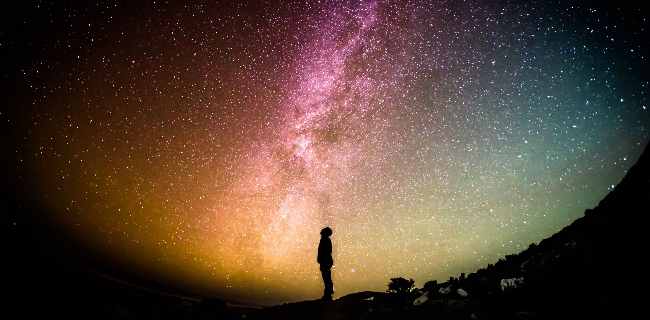
The sky doesn’t announce itself. It doesn’t ask for your attention or remind you to look up. It simply continues — indifferent, precise, ancient — whether anyone is watching or not. But the summer of 2026 is worth watching. Between June and late August, the night sky will offer a Venus-Jupiter conjunction so close the two planets nearly touch, a solar eclipse that will block out 90% of the Sun, a meteor shower capable of producing a hundred shooting stars per hour, and a blood-red lunar eclipse to close out the season.
These aren’t rare in the sense of once-in-a-lifetime — some will happen again within years. What makes them worth your time is something harder to quantify: the same events that will light up your sky this summer were recorded by Babylonian astronomers, built into Egyptian temples, and written into myths that still exist today. This guide covers what’s coming, when to look, and why — after all this time — it still matters.
The Summer Triangle: Your Starting Point
Visible: Early June through late September
If you’re new to stargazing, start here. The Summer Triangle is an asterism — a recognizable pattern — formed by three of the brightest stars in the night sky: Vega in Lyra, Deneb in Cygnus, and Altair in Aquila. It’s easy to spot, visible all summer long, and serves as a reliable anchor for navigating the rest of the sky.
Look toward the eastern horizon in early summer, or straight overhead by August. Vega is typically the first bright star to appear at dusk.
Why it matters: For centuries, these three stars were navigational and mythological anchors for civilizations across the world. The Japanese Tanabata festival, still celebrated today, is built around the story of Vega and Altair — two stars separated by the Milky Way, meeting just once a year. What’s striking is not the myth itself, but the impulse behind it: humans have always reached for narrative when confronted with the sky. We didn’t just observe. We needed to mean something by what we saw.
The Planetary Mini-Alignment — June 12
Visible: Evening of June 12, just after sunset, western horizon
Three planets — Mercury, Venus, and Jupiter — will appear to line up along the same arc in the evening sky. This kind of alignment, where planets arrange themselves along the ecliptic as seen from Earth, is called a planetary parade. This one is a “mini” alignment of three planets, but coming just days after the Venus-Jupiter conjunction (see below), it makes the second week of June one of the richest stretches of the summer for sky watchers.
Why it matters: Planetary alignments puzzled and fascinated ancient astronomers not because they were visually dramatic, but because they seemed to mean something. The planets moved while the stars didn’t. They followed patterns that could be predicted. Long before modern astronomy, tracking these movements was one of humanity’s first systematic scientific endeavors — arguably the first data science project in history.
The Cosmic Kiss: Venus Meets Jupiter — June 9
Visible: June 9, just after sunset, west-northwest horizon. No equipment needed. About one hour viewing window.
The two brightest planets in the night sky will appear to come extraordinarily close together — separated by roughly the width of a little finger held at arm’s length. This event is called a conjunction, and this one between Venus and Jupiter is exceptionally close, earning it the nickname “cosmic kiss.”
Venus and Jupiter are not actually near each other in space — they’re hundreds of millions of kilometers apart. What you’re seeing is a line-of-sight alignment, a trick of perspective from our particular vantage point on Earth.
Why it matters: Venus and Jupiter have been called the “greater and lesser benefics” in astrological traditions spanning ancient Babylon, Greece, medieval Islam, and Renaissance Europe. The convergence of the two brightest wandering lights in the sky was interpreted across nearly every pre-modern culture as a signal — of abundance, of significant beginnings, of cosmic alignment between earthly and divine realms.
From a purely astronomical standpoint, what’s remarkable is how predictable this is. We know exactly when it will happen, where to look, and for how long. The Babylonians were recording Venus cycles as far back as 1600 BCE. The question worth sitting with: what does it mean that our ancestors found deep significance in an event that we now understand to be pure geometry? Did they see something we’ve lost — or did we gain something by losing it?
The International Space Station: Humanity’s Outpost
Visible: Throughout summer, multiple passes per evening in midsummer
Summer is the best season to spot the ISS. Because nights are shorter and the Sun stays closer to the horizon, the station remains illuminated by sunlight even after dark — sometimes allowing several visible passes in a single evening. It appears as a steady, fast-moving white light, brighter than any star, crossing the sky in a matter of minutes.
You can find precise flyover times for your location at NASA’s Spot the Station site or via the Heavens-Above app.
Why it matters: There is something quietly profound about watching the ISS pass overhead. Right now, as you look up, human beings are living in that light. They are conducting experiments, looking back down at Earth, and carrying forward one of the oldest human drives: to go further, to see more, to not stay put. The ISS is the most expensive object ever built by our species. It is also one of the few things we built together.
The Strawberry Moon — June 30
Visible: June 30, rising at dusk
The first of three summer full Moons, the Strawberry Moon gets its name from Indigenous North American traditions marking the strawberry harvest season. It rises large and amber-hued near the horizon — one of the most visually striking full Moons of the year simply due to the atmospheric effect of viewing it low in the sky.
Why it matters: Every culture on Earth has named the full Moons. Not the stars, not the planets — the Moons. Monthly, reliable, bright enough to work and travel by, the full Moon was humanity’s first shared calendar. The names — Strawberry, Buck, Sturgeon — are not poetic decoration. They were functional memory systems, encoding seasonal knowledge into something anyone could look up and read. The sky as database, long before we had any other kind.
The Buck Moon — July 29
Visible: July 29
Named for the season when male deer begin growing new antlers, the Buck Moon is the midsummer full Moon. Rising in the late afternoon, it will be visible for most of the night.
Why it matters: The Buck Moon sits at the heart of summer — the point where the season feels most fully itself. Many ancient traditions held midsummer as a liminal time, a threshold between what has been planted and what will be harvested. The full Moon at this point wasn’t just an astronomical event; it was a marker in a living calendar that connected human activity to natural cycles in ways that modern timekeeping largely no longer does.
The Perseid Meteor Shower — Peak: August 12–13
Active: July 17 – August 24. Peak night: August 12–13
The Perseids are one of the most reliable and spectacular meteor showers of the year. They occur when Earth passes through the debris trail left by Comet 109P/Swift-Tuttle — particles of ice and rock burning up in our atmosphere at around 60 kilometers per second. In ideal dark-sky conditions, observers can see 60 to 100 meteors per hour at peak, including vivid fireballs that leave glowing trails across the sky.
The radiant point — the area of sky from which the meteors appear to originate — is the constellation Perseus. No telescope needed. Find a dark location, lie back, and let your eyes adjust for 20–30 minutes.
Why it matters: Shooting stars occupy a unique place in human psychology. Across almost every culture independently, a falling star became a moment to make a wish — to project intention outward into the cosmos. Why? Perhaps because the meteor is fleeting, unrepeatable, demanding presence. You either see it or you don’t. In a world of endlessly reviewable content, there is something almost radical about an event that only rewards those who are actually looking.
On a scientific level, the Perseids are also a reminder of where we come from. The organic compounds found in cometary debris are among the leading candidates for the raw materials of life on Earth. When you watch a Perseid burn up overhead, you may be watching something distantly related to the origin of everything you are.
The Partial Solar Eclipse — August 12
Visible: August 12, early evening across Europe and parts of North Africa and North America. Totality visible from Greenland, Iceland, and northern Spain.
On the same evening as the Perseid peak, the Moon will cover approximately 90% of the Sun at maximum — making this one of the most dramatic partial solar eclipses in years. For observers across much of Europe, the Sun will appear as a narrow crescent before it sets.
⚠ Safety note: Never look directly at the Sun during a solar eclipse. Use certified eclipse glasses or a pinhole projector.
Total solar eclipses occur somewhere on Earth roughly every 18 months, but seeing one from any given location happens only once every 400 years on average. The next total solar eclipse visible from the UK, for context, won’t occur until 2090.
Why it matters: No astronomical event has shaped human history more than the solar eclipse. Armies have halted. Kings have been overthrown. Calendars have been rewritten. The sudden disappearance of the Sun — the most reliable object in human experience — has triggered profound psychological ruptures across recorded history.
What’s interesting is that even today, knowing exactly what a solar eclipse is and being able to predict it to the second, people still travel thousands of kilometers to stand in the path of totality. The explanation doesn’t diminish the experience. Perhaps that tells us something important: understanding something and being moved by it are not the same process. They operate in different parts of us.
The Sturgeon Moon and Partial Lunar Eclipse — August 28
Visible: August 28, early morning hours
The final full Moon of summer is the Sturgeon Moon, named after the large freshwater fish historically caught in abundance at this time of year in North America. This one comes with a significant addition: a partial lunar eclipse in which approximately 90% of the Moon will enter Earth’s umbra — the darkest part of its shadow. As this happens, the Moon takes on a deep red or copper color, an effect caused by sunlight refracting through Earth’s atmosphere and bending onto the lunar surface.
Essentially, you’re seeing every sunrise and sunset on Earth simultaneously, projected onto the Moon.
Why it matters: The blood Moon has carried enormous symbolic weight across cultures — seen as an omen, a threshold, a moment of cosmic significance. We now know it is geometry and atmospheric optics. But the experience of watching a bright full Moon slowly darken and turn red in real time remains one of the most visually arresting things the sky can offer. Some truths about beauty don’t require mystery to remain true.
A Final Thought
What strikes you, looking at this list, is the density of it. In the span of roughly three months, we have conjunctions, alignments, meteor showers, eclipses both solar and lunar, and a near-full disappearance of the Sun. The summer sky of 2026 is not ordinary.
But in another sense, it always looks like this. The sky has been putting on versions of this show for billions of years, long before there was anyone to watch. What changes is whether we’re paying attention.
Every civilization that left records looked up. They built calendars, temples, myths, and navigation systems around what they saw. They invested enormous resources — intellectual, financial, architectural — in understanding the sky. Not because it was useful, though it was. But because it seemed to matter in some way they couldn’t fully articulate.
We are the first generation with the tools to explain almost all of it. We know what a meteor is, what causes an eclipse, why planets align. The question that summer 2026 quietly poses, if you’re willing to sit with it, is whether explanation is the same as understanding — and whether looking up still means something, even now.
📍 Observation tips:
- For meteor showers and faint objects, get at least 30 km from city lights and allow 20–30 minutes for your eyes to dark-adapt.
- For the ISS, use NASA’s Spot the Station or Heavens-Above for location-specific pass times.
- For the solar eclipse on August 12, certified eclipse glasses are essential — regular sunglasses are not sufficient.
- The Venus-Jupiter conjunction on June 9 and the planetary alignment on June 12 are both visible to the naked eye, no equipment needed.