Those Two Bright “Stars” in the Evening Sky? They’re Not Stars at All
Two unusually bright “stars” have appeared close together in the western sky after sunset. Here’s what they actually are — and why this week is the best time to look.
Two Bright “Stars” in the Evening Sky
You’ve probably noticed them by now. Two impossibly bright points of light, low in the western sky just after sunset, closer together than they have any right to be. Brighter than any star. Steady, not blinking. And if you’ve found yourself stopping mid-sentence to point at them — you’re not alone. Millions of people around the world are looking up at the same two lights this week, asking the same question: what is that?
You step outside after sunset, glance west, and there they are — two brilliant points of light hanging close together in the darkening sky, brighter than anything else up there. You wonder: are those stars? A plane? Something stranger?
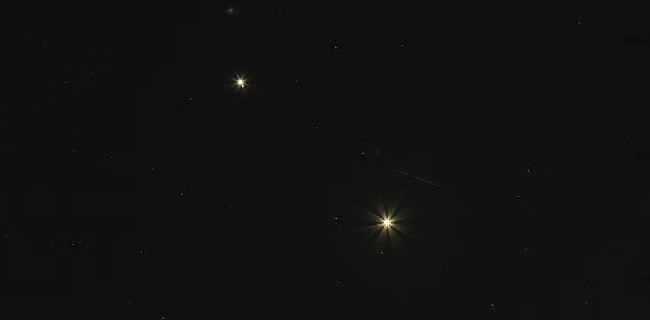
They’re planets. Specifically, Venus and Jupiter — the two brightest planets visible from Earth — and right now, in early June 2026, they’re putting on one of the most visually striking shows of the year.
What You’re Actually Seeing
When two planets appear close together in the sky, astronomers call it a conjunction. It doesn’t mean the planets are physically near each other in space — it’s a perspective effect, like two mountains on different ridges appearing to overlap when seen from a certain angle.
In this case, the geometry is almost absurdly dramatic. Venus is currently around 80 million kilometers from Earth. Jupiter is over 900 million kilometers away. And yet, from where you’re standing, they look like neighbors.
The closest approach happens on June 9, 2026, when Venus and Jupiter will be just 1.6 degrees apart — roughly three times the width of a full moon. But you don’t need to wait for the 9th. They’ve been visibly close since early June and will remain a striking pair through mid-month.
How to Find Them
The recipe is simple:
- Wait until about an hour after sunset
- Face west-northwest
- Look for the two brightest points in the sky — you genuinely can’t miss them
Venus is the dazzlingly bright one, slightly lower and to the right. Jupiter sits just above it, a touch dimmer but still far outshining any star nearby. If you have binoculars, you might even catch Mercury lurking lower on the horizon, completing an unexpectedly rich scene.
No telescope needed. No app required. Just a clear western horizon and a few minutes of patience.
Why Venus and Jupiter Look So Bright
Both planets shine not by their own light but by reflecting sunlight — and they’re exceptionally good at it.
Venus is perpetually wrapped in thick clouds of sulfuric acid that act like a giant mirror, reflecting about 70% of the sunlight that hits it. It’s the third brightest object in the entire sky, after the Sun and the Moon.
Jupiter is enormous — more than 1,300 Earths could fit inside it — and its cloud tops are highly reflective. Even from nearly a billion kilometers away, it dominates the night sky.
When these two conspire to appear close together, the result is impossible to overlook, even from a light-polluted city.
A Rare Enough Event to Notice
Venus-Jupiter conjunctions happen roughly every 13 months, but they vary wildly in visibility. Some occur too close to the Sun to observe. Others happen in the predawn sky. This one — in the evening, high enough to see clearly, at a time of year when nights are still warm — is genuinely among the more accessible ones.
After this, the next comparably close evening conjunction won’t occur until August 2027, and that one will be a daytime event, effectively invisible. The next well-placed nighttime pairing comes in November 2028.
So if you’re going to look up, this week is the week.
What Happens Next
After the June 9 peak, the two planets will slowly drift apart. Venus will climb higher in the evening sky through summer before making its exit in October 2026, passing between Earth and the Sun. Jupiter, meanwhile, will sink toward the horizon and disappear into the Sun’s glare by late June.
On June 16 and 17, there’s a bonus: a thin crescent Moon will join the scene, forming a triangle with Jupiter and Mercury on the 16th, then gliding close to Venus on the 17th. If you want a photogenic moment, that might be it.
Two bright lights in the west after sunset. Not satellites. Not aircraft. Not a glitch in the sky.
Just two of our solar system’s oldest neighbors, briefly sharing the same patch of night — and reminding anyone who happens to look up that there’s a lot going on out there.
Look west tonight. You won’t regret it.