
What Did Artemis II Astronauts See in Space?
What did the Artemis II astronauts see and experience in space? The far side of the Moon, Earthset, a total solar eclipse, communication blackouts, and the risks aboard the Orion capsule — explored.
Editor’s note: Artemis II successfully completed its mission on April 10, 2026, splashing down in the Pacific Ocean. This article has been updated to reflect the final mission data.”
What Did Artemis II Astronauts See in Space?
Humanity has spent centuries gazing up at the sky. But very few people have ever turned around — and looked back at it from the other side.
During the Artemis II mission, as the capsule passed over the far side of the Moon, astronauts witnessed one of the strangest sights in human history: Earth slowly disappearing behind the lunar horizon.
Silent. Blue. Small. Fragile.
Some astronauts struggled to put the view into words. Because from out there, Earth no longer looked like a place made of countries, borders, and cities. It looked like a single living organism.
Earthset: The Moment Earth Disappeared
Most people are familiar with “Earthrise” — the iconic image of Earth rising above the lunar horizon, first captured during the Apollo missions. But what Artemis II astronauts witnessed was the exact opposite.
As the capsule moved toward the far side of the Moon, Earth gradually faded from view. The blue planet drifted silently behind the grey, quiet lunar surface. NASA named this moment “Earthset.”
What made it so striking wasn’t just the sight. It was the silence.
There were no color transitions like an earthly sunset. No dramatic oranges or reds, because there’s no atmosphere to scatter light. Earth didn’t look like a light source — it looked like a living sphere suspended in darkness.
Several astronauts described how impossibly small Earth looked in that moment. Wars, borders, economic crises, everyday stress — from that vantage point, it all seemed to dissolve into insignificance.
Because from out there, Earth wasn’t a great civilization. It was a tiny refuge lost in an infinite universe.
Very few people in human history have ever seen that view. And most of those who have describe the same feeling:
“You can never look at Earth the same way again.”
What Did They See on the Far Side of the Moon?
The phrase “the dark side of the Moon” sounds mysterious. In reality, it simply refers to the side that’s never directly visible from Earth.
When the Orion capsule crossed to the lunar far side, the crew came face to face with a landscape that human eyes have rarely seen.
The first thing that struck them was the sheer roughness and chaos of the surface.
From Earth, the Moon looks smooth and serene. But up close, the surface was covered in massive craters, cracks stretching for kilometers, frozen lava plains, and razor-sharp ridges. Some craters were so enormous that entire cities could fit comfortably inside them.
The far side of the Moon contains significantly more craters than the near side — the result of billions of years of meteorite impacts, with no atmosphere to offer any protection.
Astronauts also described the way light struck the lunar surface as “disturbingly surreal.” Without an atmosphere, shadows were impossibly sharp. A region could be in blinding brightness one moment, and just a few meters away, plunged into absolute darkness.
And then there were the stars.
Not the twinkling stars you see from Earth. More like millions of pinpoints of light fixed into a black void — perfectly still, perfectly silent.
Several astronauts admitted they hadn’t expected space to look this quiet, this motionless. Movies usually portray space as dynamic, dramatic, loud. In reality, it was unsettlingly calm.
Perhaps that was Artemis II’s most powerful revelation: the feeling that space isn’t a movie set — it’s an actual, vast emptiness that really exists.
Why Does Looking at Earth from Space Change a Person?
The most striking thing Artemis II astronauts described wasn’t physical — it was psychological. While NASA doesn’t formally diagnose it, there’s a concept long recognized in space psychology: the Overview Effect.
Astronauts who experience this phenomenon say their perspective on humanity shifts after seeing Earth from space. Because from out there, Earth genuinely looks different.
From approximately 384,000 kilometers away:
- Countries disappear.
- Borders disappear.
- Political divisions vanish entirely.
All you see is a blue-and-white sphere wrapped in a thin veil of atmosphere.
Technically, that atmosphere is far thinner than most people imagine. If Earth were the size of an apple, the atmosphere would be roughly as thick as the apple’s skin. The Artemis II astronauts said that fragile image was especially difficult to shake.
During the mission, the Orion capsule reached speeds of approximately 39,000 kilometers per hour — among the highest ever achieved by a crewed spacecraft. Watching Earth grow smaller and smaller at that velocity can even distort an astronaut’s sense of time.
What’s remarkable is how consistently astronauts describe the same feelings.
Some become more environmentally conscious. Some begin to see human conflicts as deeply absurd. Others say it’s the first time they’ve truly felt that we are not alone — because Earth no longer looks vast; it looks like a small point of life in an endless dark.
Astronaut Victor Glover put it this way:
“From out there, we all looked like we were living in the same house.”
Astronaut Jeremy Hansen said:
“What I saw with my own eyes from the Moon blew my mind.”
The crew also witnessed a total solar eclipse from space during the mission. As the Moon passed in front of the Sun, the view was far more dramatic than any eclipse seen from Earth.
Another detail astronauts kept returning to: how Earth, seen from that distance, looked like one single living system.
The mission also set a record. The crew traveled approximately 252,756 mil from Earth — the farthest any humans have ever journeyed in history.
Perhaps Artemis II’s greatest achievement wasn’t going to the Moon. It was reminding humanity what it feels like to look at Earth from the outside.
A Total Solar Eclipse Unlike Any Other
One of the most extraordinary events of the Artemis II mission was witnessing a total solar eclipse — but one that looked nothing like the eclipses we see from Earth.
On Earth, a total eclipse typically lasts only a few minutes, because the Moon’s shadow moves quickly across the planet’s surface. But in space, especially at a position near lunar orbit, the geometry changes completely.
At certain points, the Orion capsule passed through an alignment where the Sun, Moon, and Earth were nearly in a straight line. The Moon blotted out the Sun like an enormous black disc.
According to the astronauts, the most unsettling detail was the sensation of sudden darkness.
Without an atmosphere, there was no gentle dimming like you’d experience on Earth. The sunlight simply cut out — and space transformed almost instantly into a near-total black void. Only the thin corona surrounding the Sun remained visible.
From a technical standpoint, the observation was invaluable. NASA engineers used it to analyze:
- How the Orion capsule responded to abrupt changes in light and temperature,
- How sensors behaved under sudden brightness loss,
- And radiation measurements in deep space.
Radiation is a critical challenge on deep-space missions. Once beyond Earth’s magnetic field, astronauts are exposed to significantly higher levels of high-energy cosmic particles.
Micrometeorites and the Invisible Dangers of Space
In films, space looks empty. In reality, it’s filled with constantly moving microscopic particles.
Throughout Artemis II, the Orion capsule was under continuous monitoring for micrometeoroids — tiny space rocks, some smaller than a grain of sand, that travel at tens of thousands of kilometers per hour and carry enough energy to cause serious damage.
NASA designed the Orion capsule with multi-layered protective panels specifically for this purpose — engineered to disperse the energy of an impact across a surface rather than concentrating it at a single point.
Astronauts reported occasionally feeling faint vibrations through the capsule hull. Most were harmless, but each one served as a reminder of just how harsh an environment space truly is.
On Earth, our atmosphere protects us. Millions of tiny meteors burn up in it every single day — and most of the time, we never notice.
In deep space, it’s different.
Out there, the only thing standing between you and the void is a few centimeters of metal, engineering calculations, and human ingenuity.
The Risks of the Mission
From the outside, Artemis II may have looked like a flawless mission. But the truth is, sending humans into deep space is still an enormously risky undertaking.
Lunar missions operate at a fundamentally different level than missions in low Earth orbit.
Once Orion moved beyond Earth’s magnetic field — into what’s called deep space — the crew was exposed to:
- Elevated radiation levels,
- The threat of solar flares,
- And technical failures that are far harder to address from a distance.
On the International Space Station, an emergency can be resolved with a return to Earth within hours. On a lunar mission, that’s simply not an option.
NASA engineers focused on three primary risks:
- Radiation
- Thermal extremes
- Micrometeorite impacts
The outer surface of the Orion capsule was exposed to temperatures ranging from +250°C to -150°C across different sections. The capsule’s thermal management system operated continuously throughout the mission.
A less obvious but equally serious risk was the human factor itself.
Living in a confined capsule for days affects sleep patterns, stress levels, and decision-making. For this reason, the Artemis II crew spent months in simulation training before the mission ever began.
The Silence of Lost Signal
When Artemis II passed behind the Moon, all communication with Earth was temporarily cut off. This was expected — the Moon physically blocks radio signals. While the capsule was on the far side, no audio, no video, and no data could be transmitted.
For mission control on Earth, those minutes were tense. There was nothing technically wrong — but no one on the planet could reach the crew. The entire ground team had to trust their calculations and assume the systems were functioning as designed.
This communication blackout is called LOS — Loss of Signal.
It happened during Apollo missions too, but with Artemis II, it became one of the most gripping moments of a new era of human spaceflight.
For the astronauts, the experience was stranger still.
Think about it:
- Earth was out of sight.
- No one could speak to them.
- And there was no other human being anywhere nearby.
Just the far side of the Moon and absolute silence.
The Orion Capsule: Technical Details
At the heart of Artemis II was the Orion spacecraft — one of the most advanced crewed space vehicles NASA has ever built.
The capsule is approximately 5 meters in diameter and designed to carry four astronauts into deep space. While its interior volume is larger than the Apollo capsules, it’s still remarkably compact by modern standards.
Orion’s most critical feature is its life support system, which automatically manages:
- Oxygen production,
- Carbon dioxide filtration,
- Temperature regulation,
- Water management,
- And cabin pressure.
Power is provided by solar panels on the European Service Module, developed by the European Space Agency. When fully extended, Orion’s span reaches approximately 19 meters.
On return, the capsule was designed to re-enter Earth’s atmosphere at approximately 40,000 kilometers per hour — one of the most extreme thermal environments any crewed spacecraft has ever faced.
Orion’s heat shield was engineered specifically for this. During atmospheric entry, the capsule’s outer surface can reach temperatures of approximately 2,760°C — hotter than lava.
In short, Orion isn’t just a spacecraft. It’s one of the first genuine deep-space systems designed to keep humans alive beyond Earth — for extended periods, far from home.
Artemis II: A 10-Day Historic Journey
The Artemis II mission lasted approximately 10 days. According to NASA’s official records, the exact elapsed time from launch to splashdown was 9 days, 1 hour, 32 minutes, and 15 seconds — rounded to “10 days” for public communication.
Key milestones:
- Launch: April 1, 2026
- Lunar approach: Approximately 3–4 days after launch
- Closest point to the Moon: Day 6 of the mission
- Splashdown: April 10, 2026, in the Pacific Ocean
During the mission, the crew traveled a free-return trajectory around the Moon, crossing the far side and breaking the record for the farthest distance ever traveled by humans: approximately 695,081 miles (roughly 1,118,000 km) from Earth.
Throughout the journey, the Orion capsule’s life support systems, thermal controls, navigation hardware, and deep-space communication equipment were put to the test.
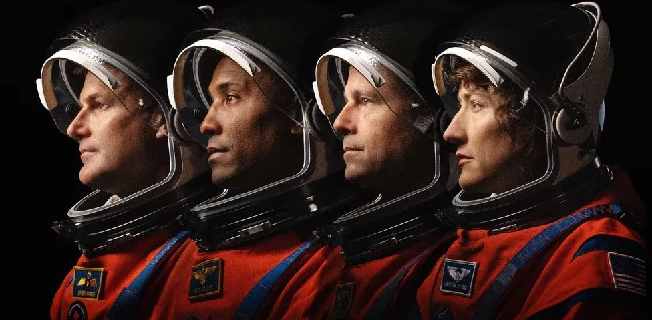
Editor’s Note: Artemis II launched on April 1, 2026, and successfully completed its mission on April 10, 2026, splashing down in the Pacific Ocean off the coast of San Diego. The crew — NASA astronauts Reid Wiseman, Victor Glover, and Christina Koch, and CSA astronaut Jeremy Hansen — traveled a record 252,756 miles from Earth during their nearly 10-day journey. This article has been updated to reflect the final mission data.
Frequently Asked Questions
What is the Artemis II mission? Artemis II is the first crewed mission in NASA’s Artemis lunar program. Astronauts traveled around the Moon and returned to Earth without landing on the surface.
Did Artemis II astronauts land on the Moon? No. The mission’s purpose was to test the Orion capsule, life support systems, and crewed deep-space flight — not to land.
Did the astronauts really see the far side of the Moon? Yes. The “dark side of the Moon” refers to the side never visible from Earth. The Artemis II crew passed directly over it and observed it firsthand.
Why did communication cut out? When Orion crossed to the far side of the Moon, the Moon itself blocked radio signals. This temporary blackout — known as Loss of Signal (LOS) — was planned and expected.
How fast was the Orion capsule? Orion reached speeds of approximately 39,000–40,000 km/h during the mission — among the highest ever recorded for a crewed spacecraft.
Is there a risk of meteor impact in space? Yes. Micrometeoroids pose a real threat. Orion was equipped with multi-layered protective shielding designed specifically to handle these impacts.
How did astronauts describe seeing Earth from space? Most described Earth as looking “small and fragile.” Many experienced what space psychologists call the Overview Effect — a profound shift in perspective about humanity and the planet.
What is the Artemis program? NASA’s Artemis program aims to return humans to the Moon, establish a sustainable lunar presence, and develop the experience needed for future Mars missions.
Why is Artemis II considered so significant? Because it marks the first time humans have traveled into deep space since Apollo 17 in December 1972. Many experts describe it as the beginning of a new era of human spaceflight.
Conclusion: Perhaps the Greatest Discovery Wasn’t the Moon
Technically, Artemis II was a spaceflight. But based on what the astronauts described, it was something far greater than that.
As humanity moved closer to the Moon again, it also learned to see itself from a distance.
The far side of the Moon, the massive craters, the absolute silence, the infinite void — all of it was extraordinary. But what people kept coming back to, after everything, was Earth.
The small blue planet.
That thin-atmosphere dot where billions of people live — where every war, every love, every fear, every dream has ever taken place.
Maybe that’s the deepest effect space has on the human mind: the farther you travel from Earth, the closer you feel to it.
Artemis II didn’t just show us what the Moon looks like. It reminded us where humanity stands in the universe. And perhaps when humans one day travel to Mars and look back — they’ll feel exactly the same thing.
Home was always smaller than we thought.
What Comes Next — And Why It Matters
When I saw the Earthset photographs — Earth slowly disappearing behind the Moon’s horizon — I didn’t think about the science. I just wanted to be there.That’s what Artemis II did that no data set ever could. It made space feel reachable. Not for engineers or astronauts alone — but for anyone who has ever looked up and wondered.And that may be the real reason these missions matter. Not just the records broken or the technology tested — but the feeling they leave behind. The quiet certainty that humanity is not done exploring.Artemis III is already in planning. A lunar landing is targeted for 2028. And somewhere out there, the next crew is training for a view that will change them forever.Maybe that’s enough reason to keep looking up.”