
Can We Travel Through a Black Hole?
Can We Travel Through a Black Hole? What Would Happen If We Tried? Discover what happens beyond the event horizon, how gravity affects time, and whether black holes could be gateways to other universes.
Imagine traveling through space in a spacecraft when you suddenly encounter a black hole. Would you be pulled inside? Could you pass through it and emerge somewhere else in the universe? Or would the journey end before you even realized what was happening?
Black holes are among the most mysterious objects in the universe. Their gravity is so powerful that not even light can escape once it crosses a certain boundary. But what would actually happen if a human tried to travel through one?
Let’s explore what science tells us.
What Is a Black Hole?
A black hole is a region of space where an enormous amount of matter is concentrated into an extremely small area, creating incredibly strong gravity.
Black holes can form when massive stars run out of fuel and collapse under their own gravity. Some grow to become millions or even billions of times more massive than the Sun.
Despite their name, black holes are not cosmic vacuum cleaners. They do not automatically suck in everything around them. Objects can orbit a black hole just as planets orbit stars, provided they remain at a safe distance.
What makes black holes truly extraordinary is what happens when something gets too close.
What Would Happen If You Entered a Black Hole?
The first major obstacle would be the black hole’s event horizon.
The event horizon is often described as the point of no return. Once something crosses this invisible boundary, it can no longer escape the black hole’s gravity, not even by traveling at the speed of light.
From that moment onward, returning to the outside universe would be impossible according to our current understanding of physics.
But crossing the event horizon might not be the most frightening part of the journey.
Would a Black Hole Stretch You Like Spaghetti?
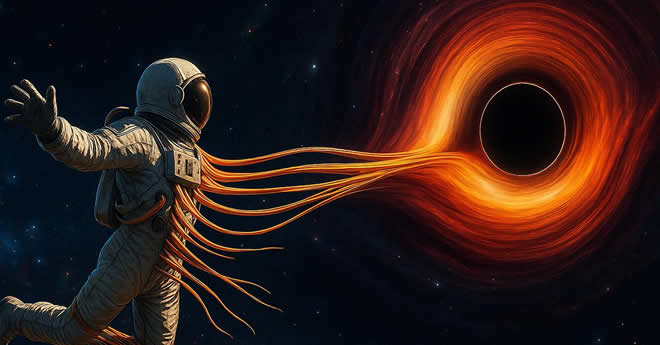
Scientists have a rather unusual name for what could happen next: spaghettification.
As you approach a black hole, its gravitational pull would become stronger on the part of your body closest to it than on the part farther away.
This difference in gravity, known as a tidal force, could stretch your body lengthwise while compressing it from the sides.
In other words, you could be stretched like a long piece of spaghetti.
The outcome depends on the black hole’s size. Near a smaller black hole, these forces could become fatal before you even reach the event horizon. Around a sufficiently large supermassive black hole, however, you might theoretically cross the event horizon without immediately noticing anything unusual at that exact moment.
That does not mean you would survive the entire journey.
Could You Travel Through Time Near a Black Hole?
Here is where things become even stranger.
According to Einstein’s theory of general relativity, gravity affects the passage of time. The stronger the gravitational field, the more slowly time passes relative to an observer farther away.
This phenomenon is called gravitational time dilation.
Imagine spending a short period near a black hole while someone else remains far away. When you eventually compare your clocks, less time may have passed for you than for the distant observer.
This does not mean you could freely travel into the future or return to the past. But it does mean that extreme gravity can change how different observers experience time.
Could a Black Hole Be a Gateway to Another Universe?
This is perhaps the most fascinating question.
Some theoretical solutions to Einstein’s equations suggest the possibility of structures called wormholes. These are sometimes described as shortcuts connecting distant regions of spacetime.
In popular science and science fiction, black holes are often portrayed as gateways to other universes or distant parts of the cosmos.
However, there is an important difference between mathematical possibilities and scientific evidence.
Scientists have not discovered a way to travel through a black hole into another universe. Nor is there observational evidence that ordinary black holes function as portals.
According to our current understanding, crossing the event horizon means there is no known way back.
What Happens at the Center of a Black Hole?
At the heart of a classical black hole lies a region known as the singularity.
According to general relativity, matter collapsing into this region reaches an extreme state where the mathematical description of spacetime breaks down.
But there is a problem: our current theories of gravity and quantum physics do not yet provide a complete explanation of what happens under such extreme conditions.
Scientists are still searching for a theory that could unite these two fundamental areas of physics.
So, what really happens inside a black hole? We do not know for certain.
So, Can We Travel Through a Black Hole?
Based on everything we currently understand, traveling through a black hole and emerging somewhere else is not a realistic possibility.
Crossing the event horizon would prevent any return to the outside universe. Extreme gravitational forces could destroy an approaching spacecraft, while the physics of the black hole’s interior remains one of the biggest unanswered questions in modern science.
Perhaps the most fascinating thing about black holes is not simply their power to trap matter and light, but how much they still have to teach us about the universe.
Could black holes hide secrets about space and time that we have not yet discovered?
For now, that question remains open.
Sources:
- NASA – What Happens When Something Gets Too Close to a Black Hole?
- NASA – Anatomy of a Black Hole
- NASA – Frequently Asked Questions on Black Holes
- European Southern Observatory – What Happens If You Fall Into a Black Hole?