November 10: On This Day in Science and Space History
What happened in science on November 10? Discover important events in science and space history that took place on November 10. Explore the Zond 6 and Luna 17 missions, the Lunokhod 1 lunar rover, solar research, and other scientific milestones.
Discover what happened on November 10 in science and space history, from the Zond 6 and Luna 17 missions to Lunokhod 1 and solar activity.
What Happened in Science and Space History on November 10?
November 10 is associated with several remarkable developments in the history of science and space exploration. The Soviet Union launched two important spacecraft, Zond 6 and Luna 17, on this date in different years as part of its lunar exploration program. November 10 is also celebrated as World Science Day for Peace and Development, established by UNESCO.
From humanity’s efforts to explore the Moon to the importance of international scientific cooperation, let’s look at some of the significant events associated with this date.
1968: The Soviet Union Launched the Zond 6 Spacecraft
On November 10, 1968, the Soviet Union launched Zond 6, an uncrewed spacecraft designed to travel around the Moon and return to Earth.
Part of the Soviet Zond program, the spacecraft was developed to test technologies that could eventually support future crewed lunar missions.
Zond 6 flew around the far side of the Moon, passing approximately 2,420 kilometers (1,504 miles) above its surface. During the mission, it captured black-and-white photographs of both the near and far sides of the Moon before beginning its return journey.
The spacecraft returned to Earth on November 17, 1968. However, a technical malfunction caused its main parachutes to detach prematurely during descent, resulting in a hard impact that destroyed the capsule. Fortunately, the photographic film was recovered.
Despite its landing failure, Zond 6 represented an important step in the Soviet Union’s efforts to develop uncrewed lunar flight technology.
1970: The Soviet Union Launched the Luna 17 Spacecraft
On November 10, 1970, the Soviet Union launched Luna 17 toward the Moon. Its primary objective was to deliver Lunokhod 1, one of the first successful remotely controlled robotic rovers designed to explore the lunar surface.
Luna 17 successfully landed in the Sea of Rains (Mare Imbrium) on November 17, 1970. Following the landing, the eight-wheeled Lunokhod 1 rover descended from the landing platform and began its exploration of the lunar surface.
Lunokhod 1: The First Successful Robotic Rover on the Moon
November 17, 1970: Lunokhod 1 began exploring the lunar surface.
Weighing approximately 756 kilograms (1,667 pounds), Lunokhod 1 was remotely operated by a team of controllers on Earth. The rover was designed to study the physical properties of the lunar surface, analyze soil characteristics, and transmit images of its surroundings.
Originally designed to operate for just three lunar days, the rover far exceeded expectations. Lunokhod 1 remained operational for 322 Earth days and traveled approximately 10.54 kilometers (6.55 miles) across the Moon.
During its mission, the rover transmitted more than 20,000 television images and 206 high-resolution panoramic images to Earth. It also conducted 25 chemical analyses of lunar soil and performed mechanical measurements at various locations.
The data collected by Lunokhod 1 significantly improved scientific understanding of the Moon’s physical and geological properties. The mission marked an important milestone, demonstrating that robotic vehicles could conduct extended scientific research on the surface of another celestial body.
Key mission dates:
- November 10, 1970: Luna 17 was launched from Earth.
- November 17, 1970, 03:46 UTC: Luna 17 landed on the lunar surface.
- November 17, 1970, 06:28 UTC: Lunokhod 1 rolled down the landing ramps and began its exploration.
Lunokhod 1 was one of the first successful robotic rovers to explore the lunar surface in 1970.
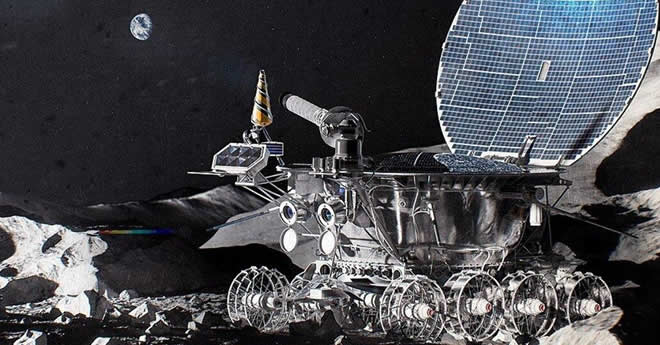
Lunokhod 1 Soviet lunar rover exploring the Moon in 1970.1990: The Hubble Space Telescope Began Observing Quasars
Beginning its scientific observations in 1990, the Hubble Space Telescope opened new possibilities for astronomers studying quasars located billions of light-years away.
Quasars are extremely bright galactic cores powered by supermassive black holes. As surrounding matter falls toward these black holes, enormous amounts of energy are released, making quasars visible across vast cosmic distances.
Hubble’s high-resolution imaging capabilities played an important role in studying the galaxies surrounding quasars and investigating phenomena such as gravitational lensing. These observations contributed to research into galaxy evolution, black holes, and the early universe.
November 10: World Science Day for Peace and Development
November 10 is significant not only for space exploration but also for highlighting the role of science in society.
Established by UNESCO in 2001, World Science Day for Peace and Development is celebrated annually on November 10. First observed worldwide in 2002, the day aims to strengthen the connection between science and society and encourage greater public understanding of scientific developments.
The main objectives of World Science Day include raising scientific awareness, promoting international scientific cooperation, and supporting the use of knowledge for the benefit of humanity.
2026 Theme: Common Ground Through Science Diplomacy
This year’s theme highlights how scientific cooperation can contribute to dialogue, trust, and the development of shared solutions in international relations.
2025: X1.2 Solar Flare and Geomagnetic Storm Alert
On November 10, 2025, a powerful X1.2-class solar flare erupted from an active region on the Sun known as AR4274. Recorded at 09:19 UTC by NOAA’s Space Weather Prediction Center (SWPC), the event was a notable example of intense solar magnetic activity.
The eruption was accompanied by a coronal mass ejection (CME), a large release of plasma and magnetic fields from the Sun. According to records from NASA’s Community Coordinated Modeling Center (CCMC), the shock wave associated with this CME reached Earth on November 11.
On November 10, NOAA issued a G1 (minor) geomagnetic storm alert due to incoming coronal mass ejections that could affect Earth. For the following days, the agency also announced the possibility of G2 (moderate) and G3 (strong) geomagnetic storms.
Solar flares and coronal mass ejections can cause temporary disturbances in Earth’s magnetic field. These events can increase the chances of aurora sightings at high latitudes and may also affect satellite systems, radio communications, and certain technological infrastructures.
This event was another reminder of how the Sun’s magnetic activity can influence space weather conditions around Earth.
The Significance of November 10 in Science and Space History
November 10 brings together important milestones from different periods in humanity’s journey to explore the universe. In 1968, the Soviet Union’s Zond 6 spacecraft conducted an uncrewed lunar flyby, contributing to the development of lunar exploration technologies. Two years later, Luna 17 was launched on November 10, 1970, carrying the Lunokhod 1 robotic rover and opening a new chapter in space exploration.
Scientific and technological progress, however, extends far beyond the early lunar missions. The Hubble Space Telescope’s observations of distant regions of the universe, robotic explorers studying different celestial bodies, and research into the effects of solar activity on Earth all demonstrate humanity’s continuing efforts to understand the cosmos.
Another important aspect of November 10 is World Science Day for Peace and Development, established by UNESCO. This annual observance reminds us of the importance of sharing scientific knowledge, encouraging international cooperation, and using technological progress to build a better future for humanity.
From the first robotic explorers sent to the Moon to modern space telescopes studying distant galaxies and the Sun, every new discovery expands our understanding of the universe. Humanity’s scientific journey is far from over, and countless mysteries are still waiting to be explored.