
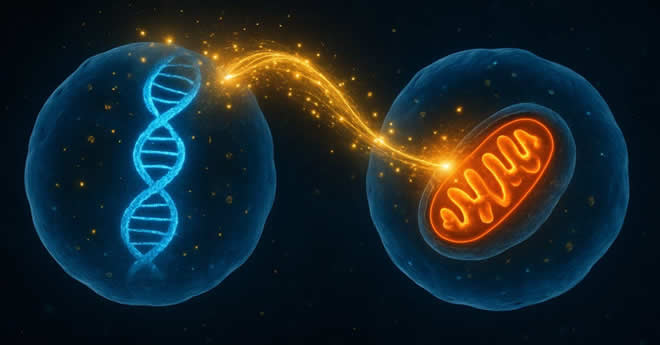
Do Mitochondria Communicate Through Light?
Can mitochondria communicate through light? Explore biophotons, mitochondrial light emission, and the fascinating scientific research into how cells may communicate through light.
Every living cell depends on complex communication systems to survive. Cells exchange chemical signals, respond to environmental changes, regulate their metabolism, and coordinate essential biological processes.
But what if chemical molecules are not the only means of communication between cellular structures?
Scientists have long studied an intriguing phenomenon: living cells can emit extremely faint light during metabolic activity. These tiny emissions, often called biophotons, have raised an important question in modern biology: Could light also play a role in communication between cells and their internal structures?
A research paper published on September 22, 2023, in Frontiers in Physiology reported experimental evidence suggesting that physically and chemically separated mitochondria can influence each other’s activity.
The findings raised new questions about the possible role of light in biological communication. Although the proposed mechanism has not yet been fully established, the research offers an interesting direction for studying cellular biology.
What Are Mitochondria and Why Are They Important?
Mitochondria are specialized structures inside most human cells. They are commonly described as the powerhouses of the cell because they play a central role in producing adenosine triphosphate, or ATP.
ATP is the primary energy-carrying molecule used by cells. It supports numerous biological activities, including muscle contraction, nerve signaling, protein synthesis, and cell maintenance.
However, mitochondria do much more than generate energy.
They also participate in calcium regulation, cellular metabolism, oxidative stress responses, and programmed cell death. Their activity influences many processes that determine how cells function and respond to their surroundings.
Scientists are now investigating whether mitochondria may also participate in communication mechanisms involving extremely weak light emissions.
What Are Biophotons? Do Human Cells Really Emit Light?
Biophotons are photons associated with biological systems. In scientific literature, the phenomenon is more commonly described as ultra-weak photon emission (UPE).
Unlike the visible glow produced by fireflies through bioluminescence, the light emitted by human cells is extraordinarily faint.
It cannot normally be detected by the naked eye and requires highly sensitive optical instruments.
One important source of this emission is cellular metabolism, particularly oxidative chemical reactions.
During mitochondrial energy production, reactive oxygen species (ROS) can interact with nearby biological molecules, including lipids, proteins, and DNA. These reactions may produce electronically excited molecular states. As these molecules return to lower energy states, they can release photons.
Mitochondria are therefore considered an important source of ultra-weak photon emission.
However, detecting photons from living cells does not automatically demonstrate that those photons are being used as communication signals. Establishing such a function requires additional experimental evidence.
The History of Biophoton Research: An Idea Dating Back to 1923
The scientific interest in biological light emission goes back more than a century.
In 1923, Russian biologist Alexander Gurwitsch conducted experiments using onion root tips. He proposed that one root could influence cell division in another root without direct physical contact.
In his experimental setup, the roots were separated by a quartz barrier. Gurwitsch suggested that a form of electromagnetic radiation might be responsible for the observed effect.
He called the proposed phenomenon mitogenetic radiation.
His experiments attracted considerable scientific interest, but the results were controversial. Later researchers raised questions about reproducibility, experimental controls, and alternative explanations.
For this reason, Gurwitsch’s original findings should be understood as an early hypothesis rather than definitive proof of light-based cellular communication.
The 1950s and 1960s: Detecting Light From Living Systems
The development of more sensitive photon-detection instruments during the 1950s and 1960s allowed scientists to investigate extremely faint light emissions from biological samples.
In 1954, Italian researchers Colli and Facchini published an important early study on photon emission from plants.
During the early 1960s, Russian research groups investigated spontaneous light emission from animal tissues and cells.
By 1965, research had increasingly linked mitochondrial activity with a substantial proportion of biological photon emission.
These developments helped establish ultra-weak photon emission as a subject of experimental biophysics.
1984: The Term Biophoton Becomes More Widely Known
German biophysicist Fritz-Albert Popp helped popularize the term biophoton in 1984.
The term describes photons associated with biological systems and became influential in discussions about possible non-chemical communication in living organisms.
Some of the broader theories associated with biophotons, including proposals involving coherent light fields, remain controversial and have not been established as accepted biological mechanisms.
The 2023 Study: Can Mitochondria Influence Each Other Through Light?
One of the most interesting recent experimental investigations was conducted by Rhys R. Mould and colleagues.
Their paper, titled Non-chemical signalling between mitochondria, was published on September 22, 2023, in Frontiers in Physiology, under the journal’s Biophysics section.
The research involved scientists from the Research Centre for Optimal Health at the University of Westminster in London and The Guy Foundation in Dorset, United Kingdom.
The authors were:
- Rhys R. Mould
- Ifigeneia Kalampouka
- E. Louise Thomas
- Geoffrey W. Guy
- Alistair V. W. Nunn
- Jimmy D. Bell
The researchers investigated whether isolated mitochondria could influence the activity of other mitochondria without direct chemical contact.
How Was the Experiment Conducted?
The research team obtained mitochondria from two different human cell lines:
- MCF7: A human breast cancer cell line.
- MCF10A: A non-cancerous human breast epithelial cell line.
The isolated mitochondria were placed in separate quartz cuvettes.
Researchers introduced antimycin, an inhibitor of the mitochondrial electron transport chain, into one of the cuvettes to induce oxidative stress.
They then measured oxygen consumption in neighboring mitochondrial samples that were physically and chemically separated from the treated sample.
The experimental arrangement included two important conditions.
In one condition, light could pass between the cuvettes. In another, an opaque barrier was used to block light transmission.
Chemical transfer between the containers was also restricted through the experimental design.
What Did the Researchers Discover?
The researchers observed changes in oxygen consumption in mitochondria that were not directly exposed to the chemical stressor.
The responses differed depending on the origin of the mitochondria and the surrounding light conditions.
In particular, the experiments showed differences between light-exposed and light-shielded conditions.
The findings supported the possibility of non-chemical signaling between physically separated mitochondrial populations.
The researchers suggested that the observed effects might involve light-based communication, potentially associated with ultra-weak photon emission.
However, an important scientific distinction must be made: the experiment did not directly identify and measure the photons responsible for a specific communication signal.
The precise mechanism remains unknown, and further experiments are needed to determine whether light itself carries the signal or whether other non-chemical processes are involved.
How Do Scientists Detect Biophotons?
The light emitted by biological systems is far too faint for ordinary cameras or human vision.
Researchers therefore use highly sensitive instruments, including photomultiplier tubes (PMTs), to detect individual photons and measure extremely low levels of light emission.
These instruments can help scientists investigate:
- Photon emission intensity.
- Changes in emission over time.
- Spectral characteristics of the emitted light.
- Differences between biological samples under different metabolic conditions.
One major challenge is distinguishing genuine biological photon emission from background light, instrument noise, and other environmental effects.
Another challenge is separating the existence of photon emission from the much more difficult question of whether photons have a functional role in cellular communication.
A 2024 Scientific Review Revisited the Evidence
On February 14, 2024, Frontiers in Physiology published another relevant paper titled Ultra weak photon emission – a brief review.
The review examined the history, proposed mechanisms, potential biological functions, and possible applications of ultra-weak photon emission.
It discussed research involving plants, bacteria, fungi, animal tissues, and isolated cells.
The authors highlighted how advances in photon-detection technology have made it easier to investigate extremely faint biological light emissions.
They also emphasized that the potential biological functions of these photons require further investigation.
The review is particularly useful because it places the 2023 mitochondrial experiment within a much broader scientific history.
Are Human Beings Actually Light-Based Organisms?
The idea that human beings are fundamentally light-based organisms is an intriguing interpretation, but it goes beyond what current experimental evidence demonstrates.
It is scientifically reasonable to say that human cells emit extremely weak photons as a by-product of metabolic processes.
It is also reasonable to investigate whether these photons could participate in communication between cellular structures.
However, current research does not establish that human consciousness is generated by biophotons, that the body functions as a unified optical communication network, or that humans are fundamentally made of light.
These are much broader claims that require evidence beyond the experiments currently available.
The most important question is therefore not whether human cells emit light. Researchers have already investigated and documented this phenomenon.
The more challenging question is whether this light carries biological information and, if so, how cells detect and interpret it.
The Future of Biophoton Research
Biophoton research brings together several scientific disciplines, including biophysics, cell biology, mitochondrial research, and optical imaging.
Future experiments may help scientists determine whether ultra-weak photon emission has a functional role in cellular signaling.
A better understanding of this process could also contribute to research into oxidative stress, mitochondrial dysfunction, cellular metabolism, and potential non-invasive diagnostic techniques.
For now, the evidence suggests that living cells are more optically active than we once thought.
The possibility that light may play a role in the communication systems of life remains an intriguing scientific question — one that deserves careful investigation rather than premature conclusions.
Scientific References
- Mould, R. R. et al. (2023). Non-chemical signalling between mitochondria. Frontiers in Physiology.
- Mould, R. R. et al. (2024). Ultra weak photon emission – a brief review.
- Volodyaev, I. & Beloussov, L. V. (2015). Revisiting the mitogenetic effect of ultra-weak photon emission.
- Integrating Ultra-Weak Photon Emission Analysis in Mitochondrial Research (2020).
This article is based on published scientific studies and reviews. The proposed role of biophotons in cellular communication remains an active area of research.