Voyager 1 and 2: Humanity’s Longest-Running Space Mission
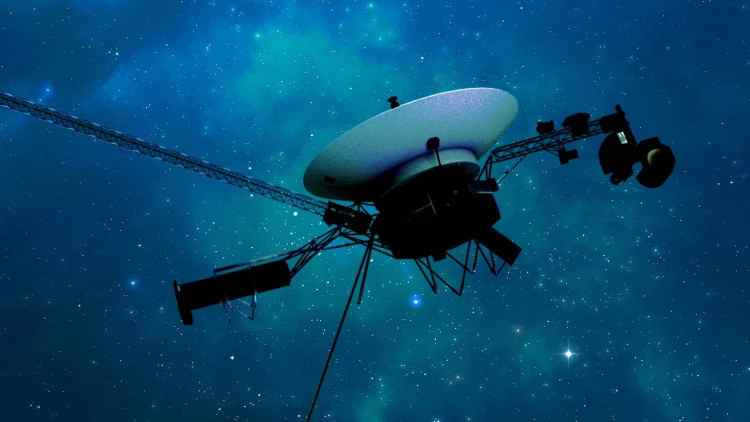
Voyager 1 and Voyager 2 are among the most remarkable spacecraft ever built. Launched in 1977, the twin probes explored the outer planets before continuing their journey into interstellar space. Where are they now? Are they still working? What did they discover, and what message are they carrying into the stars?
What Are Voyager 1 and Voyager 2?
In 1977, NASA launched two spacecraft toward the outer Solar System: Voyager 1 and Voyager 2.
Their original mission was to study the giant planets Jupiter and Saturn. Voyager 2 was later given an extraordinary opportunity to continue toward Uranus and Neptune, making it the only spacecraft ever to visit all four of the Solar System’s giant planets.
Voyager 1 took a different route. After its encounters with Jupiter and Saturn, it continued outward and eventually became the first human-made spacecraft to enter interstellar space in 2012.
Today, both spacecraft are still traveling through the space between the stars.
And remarkably, after nearly five decades, they are still sending scientific data back to Earth.
When Were Voyager 1 and Voyager 2 Launched?
Although their names suggest otherwise, Voyager 2 was launched first.
- Voyager 2: August 20, 1977
- Voyager 1: September 5, 1977
The two spacecraft were designed as near-identical twins. Their missions were based on a rare alignment of the outer planets that allowed spacecraft to use the gravity of one planet to help them reach the next. This technique is known as a gravity assist.
Voyager 1 followed a faster trajectory and eventually overtook Voyager 2.
Despite launching second, Voyager 1 reached Jupiter and Saturn first and later became the most distant human-made object ever sent into space.
What Did Voyager 1 and 2 Discover?
The Voyager missions transformed our understanding of the outer Solar System.
Jupiter
When the Voyager spacecraft reached Jupiter in 1979, they revealed a world far more dynamic than scientists had expected.
Voyager 1 discovered active volcanoes on Io, Jupiter’s innermost major moon. It was the first time active volcanism had been observed beyond Earth.
The spacecraft also studied Jupiter’s atmosphere, magnetic field, rings and moons.
Saturn
Voyager 1 and Voyager 2 both visited Saturn and returned remarkable images of its rings and moons.
Voyager 1 also made important observations of Titan, Saturn’s largest moon, including its thick atmosphere.
Uranus
Voyager 2 became the first and only spacecraft to visit Uranus in 1986.
It returned the first close-up images of the planet and discovered new details about its rings, atmosphere, magnetic field and moons.
Neptune
In 1989, Voyager 2 reached Neptune.
It remains the only spacecraft ever to visit Neptune.
Voyager 2 revealed Neptune’s powerful winds, atmospheric storms, rings and its large moon Triton.
The Pale Blue Dot
One of Voyager 1’s most famous achievements happened long after its planetary encounters.
On February 14, 1990, Voyager 1 turned its cameras back toward the Solar System from roughly 6 billion kilometers away.
Among the images was a tiny photograph of Earth.
The planet appeared as an almost insignificant point of light against the darkness of space.
The image became known as the “Pale Blue Dot.”
Astronomer Carl Sagan later used the photograph to reflect on humanity’s place in the cosmos. The image became much more than a scientific photograph. It became a reminder of how small and fragile our world appears when viewed from the vastness of space.
Where Are Voyager 1 and Voyager 2 Now?
The planetary missions eventually ended, but the Voyager journey did not.
Both spacecraft continued outward until they crossed the heliopause, the boundary between the Sun’s heliosphere and interstellar space.
Voyager 1 crossed this boundary in August 2012.
Voyager 2 followed in November 2018.
This means both spacecraft are now traveling through interstellar space, outside the heliosphere.
They are still moving away from the Sun and studying the environment between the stars.
Is Voyager 1 Still Working in 2026?
Yes.
Voyager 1 is still operating in 2026, although its available electrical power is steadily declining.
The spacecraft is powered by radioisotope thermoelectric generators (RTGs). These systems convert the heat produced by the radioactive decay of plutonium-238 into electricity.
The power supply decreases by roughly 4 watts per year, so NASA engineers have gradually switched off instruments and other systems to conserve energy.
The spacecraft is now focused on the scientific instruments most useful for studying the heliosphere and interstellar space.
In April 2026, NASA switched off Voyager 1’s Low-Energy Charged Particles (LECP) instrument to save power. Other instruments continue to operate.
So Voyager 1 is not “dead.”
It is an aging spacecraft operating on a shrinking energy budget, still sending information from a region no human spacecraft had ever reached before.
Is Voyager 2 Still Working in 2026?
Yes. Voyager 2 is also still operating.
Like its twin, Voyager 2 is gradually losing electrical power and NASA is turning off instruments to extend the mission.
NASA’s current spacecraft information lists three active science experiments on Voyager 2, including the Cosmic Ray Subsystem, Magnetometer and Plasma Wave Subsystem.
Voyager 2’s continued observations are especially valuable because it is exploring a different path through interstellar space than Voyager 1.
How Does Voyager Still Communicate With Earth?
The Voyagers communicate with Earth using their high-gain antennas and NASA’s Deep Space Network (DSN).
The spacecraft’s radio signals are incredibly weak by the time they reach Earth. Large antennas on Earth receive those signals and extract the scientific information hidden inside them.
Because the spacecraft are so far away, communication is not instantaneous.
A command sent from Earth can take many hours to reach a Voyager spacecraft, and the response takes many more hours to return.
In other words, operating Voyager is less like controlling a modern spacecraft in real time and more like having an extremely slow conversation across interstellar space.
The Golden Record: Humanity’s Message to the Stars
Voyager 1 and Voyager 2 carry something unusual alongside their scientific instruments: the Golden Record.
Each spacecraft carries a gold-plated copper record containing sounds, images, music and greetings from Earth.
The record includes:
- Images representing life and humanity on Earth
- Natural sounds such as wind, thunder and animal calls
- Music from different cultures
- Greetings in dozens of human languages
- Scientific information about Earth and human life
The Golden Record was created with the involvement of astronomer Carl Sagan and his team.
It was designed as a kind of message in a bottle for the cosmos.
There is no guarantee that another civilization will ever find it.
But that may not be the point.
The Golden Record represents humanity’s desire to introduce itself to the universe.
Why Are Voyager 1 and 2 So Different?
The two spacecraft were built as twins, but their missions eventually took very different paths.
Voyager 1:
- Reached Jupiter and Saturn
- Studied Saturn’s moon Titan
- Took the famous Pale Blue Dot image
- Entered interstellar space in 2012
- Became the most distant human-made spacecraft
Voyager 2:
- Reached Jupiter and Saturn
- Continued to Uranus
- Became the first spacecraft to visit Uranus
- Continued to Neptune
- Became the first spacecraft to visit Neptune
- Entered interstellar space in 2018
A simple way to put it is:
Voyager 1 went farther. Voyager 2 saw more planets.
10 Fascinating Facts About the Voyager Spacecraft
1. Voyager 2 launched before Voyager 1.
Despite its name, Voyager 2 left Earth 16 days earlier.
2. They are almost identical twins.
NASA designed the spacecraft using essentially the same basic architecture.
3. Voyager 1 is the most distant human-made object.
No spacecraft has traveled farther from Earth.
4. Voyager 1 discovered active volcanoes on Io.
The discovery revealed that volcanic activity exists beyond Earth.
5. Voyager 2 is the only spacecraft to have visited Uranus and Neptune.
6. Both spacecraft carry the Golden Record.
7. Voyager 1 photographed Earth from billions of kilometers away.
The resulting image became the famous Pale Blue Dot.
8. Their computers are extremely primitive by modern standards.
The spacecraft were designed in the 1970s, long before smartphones and modern personal computers.
9. Their power systems are still working nearly 50 years later.
But the available power is slowly declining, forcing NASA to turn off instruments one by one.
10. The Voyagers will continue traveling even after communication ends.
One day, their electrical power will become too low to maintain communication with Earth. But the spacecraft themselves will continue drifting through interstellar space.
How Long Will the Voyager Missions Continue?
There is no exact date when the Voyager missions will end.
The limiting factor is not fuel in the traditional sense. It is electrical power.
As the RTGs gradually produce less electricity, NASA must decide which systems are essential and which can be switched off.
Eventually, there will not be enough power to operate the communication system.
When that happens, Earth will stop hearing from the Voyagers.
But the spacecraft will not stop moving.
They will continue their silent journey through interstellar space for an unimaginably long time.
Will There Be a Voyager 3?
As of 2026, NASA does not have an official mission called Voyager 3.
That does not mean the idea of another interstellar spacecraft is impossible.
Future missions could use technologies far more advanced than those available in 1977, including improved communications, more efficient power systems and more capable scientific instruments.
The Voyagers showed that humanity can build a spacecraft capable of surviving for decades beyond the planets.
Future missions may take that idea even farther.
What Comes After Voyager?
The Voyager missions will eventually fall silent, but the questions they helped inspire will remain.
Humanity will continue trying to understand what lies beyond the heliosphere and how our Solar System interacts with the space between the stars.
Perhaps one day, a new spacecraft will follow the path opened by Voyager 1 and Voyager 2.
It may travel farther, communicate more efficiently and carry instruments that can reveal things the Voyagers could never see.
And perhaps it will carry another message from Earth.
Because the most remarkable thing about Voyager may not be how far it has traveled.
It is why we sent it in the first place.
We wanted to know what was out there.
We wanted to see what was beyond the familiar.
And almost half a century later, two small machines are still carrying that curiosity into the darkness.
Voyager 1 and Voyager 2 are not simply spacecraft. They are time capsules of human curiosity, engineering and imagination — still traveling toward the stars.